

Written by the Carpet Flooring Supplies team
Practical buying guidance based on current manufacturer information and our experience supplying flooring products.
For a conventional stretch-fit carpet, choose gripper that suits the subfloor and the intended installation. Pre-nailed gripper for timber floors and gripper designed for concrete are common starting points, but the carpet, subfloor condition and fitting method must all agree.
Quick comparison
| Situation | Starting point | Check before ordering |
|---|---|---|
| Timber floor | Pre-nailed timber-floor gripper | Check for hidden pipes, cables and unsuitable boards before fixing |
| Concrete floor | Concrete-floor gripper or an approved adhesive method | The slab must be sound, dry and suitable for the fixing |
| Stairs | Gripper and layout specified for the stair carpet | Treads, risers and nosings require an experienced fitter |
| Doorway | Gripper plus the correct transition profile | Do not use gripper as a substitute for a door bar |
What does carpet gripper do?
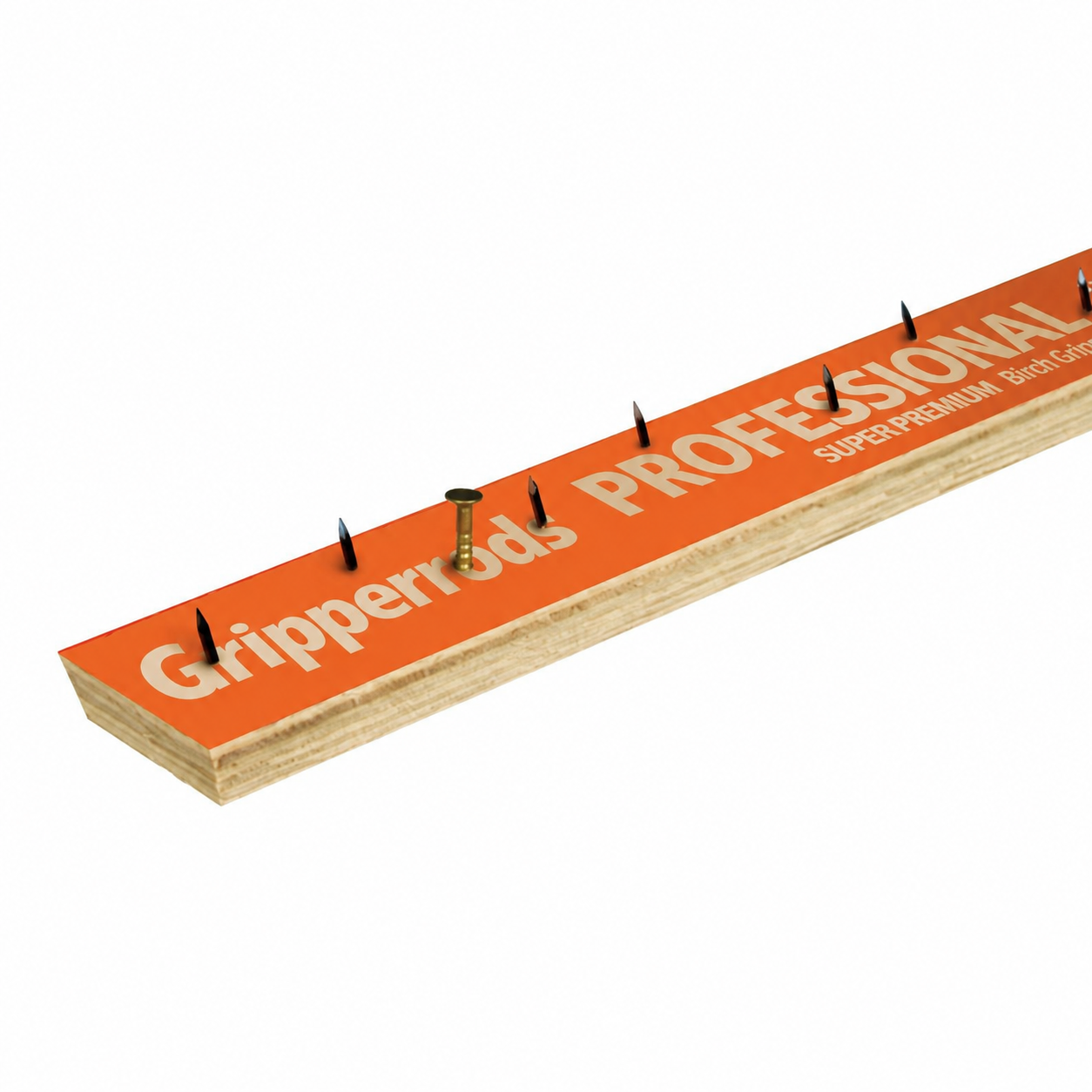
Carpet gripper is a narrow strip carrying angled pins. In a stretch-fit installation, the carpet edge is tensioned onto those pins while the gripper is secured near the room perimeter. The pins should face towards the wall so they hold the stretched carpet.
Gripper is only one part of the system. The carpet must be suitable for stretch fitting, the underlay must finish neatly inside the gripper, and the subfloor must accept the chosen fixing. Double-stick and other bonded systems follow different instructions.
Timber or concrete: which gripper should you choose?
The fixing is the key difference. Timber-floor gripper normally uses pre-fitted nails intended to enter a suitable wooden subfloor. Concrete-floor products use hardened fixings or another manufacturer-approved method.
Do not hammer blindly where pipes, heating cables or electrical services may be present. A weak screed, brittle edge or heated floor may require a different fixing plan. Ask the fitter to inspect the floor before ordering large quantities.
How much carpet gripper do you need?
Measure the perimeter where carpet will meet walls, excluding open doorways and any edge that the fitter says will use a different detail. Add the lengths, allow for cuts and round up to the pack quantity sold.
For a rectangular 4m by 3m room, the full perimeter is 14m. If one 0.8m doorway is excluded, the starting length is 13.2m before cutting allowance. Irregular rooms, hearths, wardrobes and bay windows change the total.
What gap should be left at the skirting?
The gripper sits close to the skirting with a small tuck gap for the carpet edge. There is no reliable universal gap because carpet thickness, backing and installation system vary. The fitter should set it for the actual carpet; placing the strip tight against the skirting leaves nowhere to tuck the edge.
What about stairs and doorways?
Stairs need careful positioning around treads, risers and nosings. Poorly positioned gripper can affect appearance and security, so stair work is best confirmed by an experienced carpet fitter.
At a doorway, use the transition profile that matches the two floor coverings and their finished heights. Our door-bar guide explains the main profiles.
Final checks before ordering
- Confirm the exact product name, construction, colour and selected width or length.
- Read the current manufacturer specification, room-suitability information, fitting method and warranty conditions.
- Measure the physical layout rather than relying only on square metres, and ask the fitter to approve quantities and joins.
- Check the subfloor, doors, transitions, stairs and any underfloor-heating requirements.
- Review the current CFS product page for delivery coverage, pack sizes and selectable options before payment.
Keep the sample and order confirmation until fitting is complete. Product photographs are useful for recognition, but screens and lighting can change colour. Where the retailer page, a general guide and the exact manufacturer's instructions differ, obtain confirmation for the product being installed.
Frequently asked questions
Do I need carpet gripper with felt-backed carpet?
It depends on the carpet and fitting method. Some felt-backed carpets can be fitted by more than one method. Follow the carpet manufacturer's instructions and agree the method with the fitter.
Can old gripper be reused?
Only if the fitter confirms that it is secure, correctly positioned, undamaged and suitable for the new carpet. Loose timber, rust, missing pins or the wrong gap are reasons to replace it.
Should gripper pins face the wall?
In a conventional stretch-fit perimeter installation, yes. The angled pins face towards the wall so the tensioned carpet is held at the edge.
Can carpet gripper be used over underfloor heating?
Do not fix into a heated floor without the heating-system instructions and a confirmed service layout. An adhesive or different perimeter detail may be required.
Sources and further guidance
Product ranges and specifications can change. Confirm the current product page and manufacturer instructions before ordering.