

Written by the Carpet Flooring Supplies team
Practical buying guidance based on current manufacturer information and our experience supplying flooring products.
Choose a door bar by identifying the floor covering on each side of the doorway. A carpet-to-carpet joint normally needs a different profile from carpet meeting vinyl, laminate or another hard surface. Finished floor heights and the fixing base matter as much as the finish colour.
Quick comparison
| Situation | Starting point | Check before ordering |
|---|---|---|
| Carpet to carpet | Dual-edge carpet profile | Both carpet edges need secure retention |
| Carpet to vinyl or low hard floor | Single-edge carpet profile | One side grips carpet; the other finishes against the hard floor |
| Laminate or wood to hard floor | Hard-floor transition or ramp profile | Allow for movement gaps required by the flooring |
| Noticeable height difference | Ramped transition | Confirm the supported height range before ordering |
Start with the two floor coverings
Write down the exact construction on both sides: carpet, sheet vinyl, luxury vinyl tile, laminate, engineered wood or another finish. Product names such as single edge and dual edge describe what the profile is designed to retain, not simply its appearance.
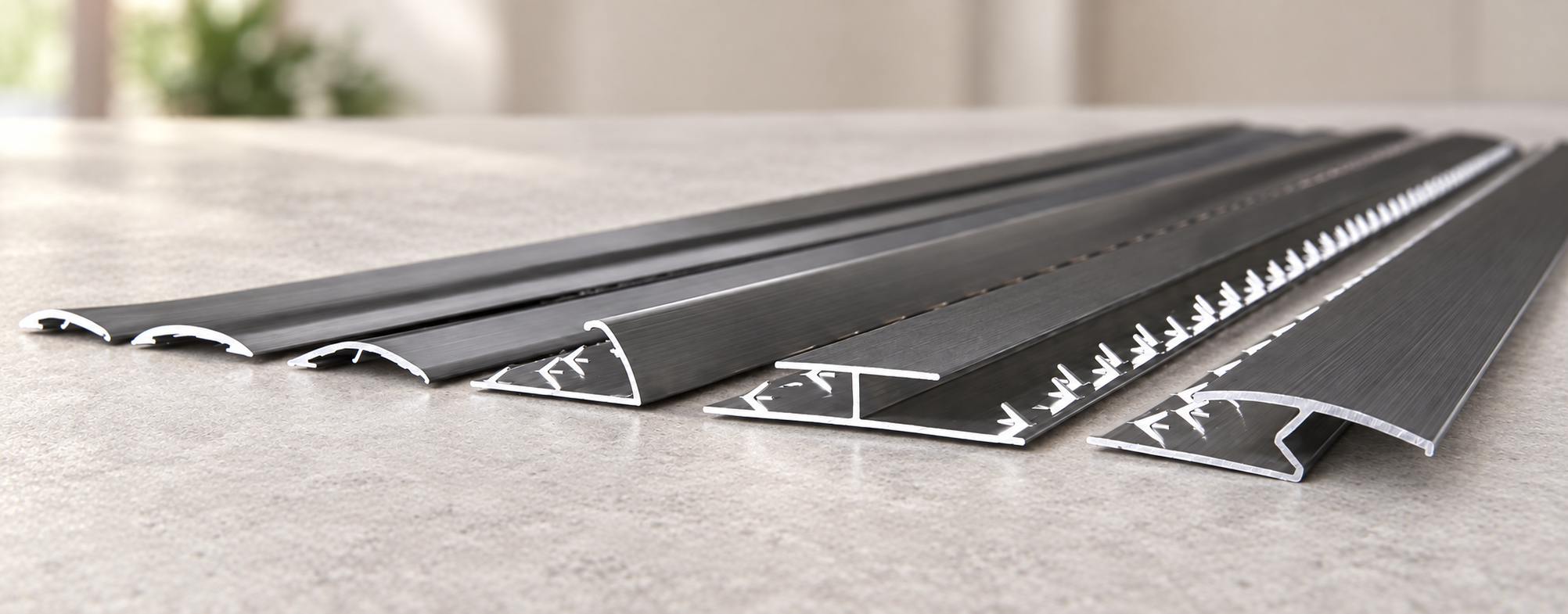
A dual-edge bar has gripping sides for two carpet edges. A single-edge carpet profile grips carpet on one side and provides a finished edge beside a lower hard covering on the other. Hard-floor profiles may cover movement gaps rather than grip textile flooring.
Check finished height, not just material thickness
Carpet compresses and sits over underlay; laminate or engineered wood may sit over its own underlay. Compare the completed levels rather than the loose materials on a table.
A profile that is too low can pinch or distort the flooring. One that is too high can rock, leave a trip edge or fail to hold the carpet. Adjustable or ramped products can cover a stated range, but the exact product specification controls the fit.
How long should the door bar be?
Measure the finished opening at the position where the bar will sit. Standard internal-door products are often sold around 0.9m, while longer lengths are available for wide openings. Check the exact selectable length on the product page and allow the fitter to cut it accurately.
Do not assume the visible door leaf width is the required cut. Linings, stops, angles and the position of the closed door affect where the transition looks neatest.
Choose the fixing for the subfloor
Some profiles are supplied for screw or nail fixing; others use concealed bases or adhesives. Check for pipes, cables and underfloor heating before drilling. The base must be sound and compatible with the fixing.
Expansion-sensitive floors need their specified movement allowance. A door bar should cover and protect the transition without trapping a floating floor that needs to move.
Finish and practical use
Gold, aluminium, chrome and darker brushed finishes can coordinate with handles and nearby fittings. First confirm profile and height compatibility, then choose the finish. In busy routes, a secure low transition matters more than matching a photograph on screen.
Final checks before ordering
- Confirm the exact product name, construction, colour and selected width or length.
- Read the current manufacturer specification, room-suitability information, fitting method and warranty conditions.
- Measure the physical layout rather than relying only on square metres, and ask the fitter to approve quantities and joins.
- Check the subfloor, doors, transitions, stairs and any underfloor-heating requirements.
- Review the current CFS product page for delivery coverage, pack sizes and selectable options before payment.
Keep the sample and order confirmation until fitting is complete. Product photographs are useful for recognition, but screens and lighting can change colour. Where the retailer page, a general guide and the exact manufacturer's instructions differ, obtain confirmation for the product being installed.
Frequently asked questions
What door bar joins carpet to carpet?
A dual-edge carpet profile is the usual starting point because it retains carpet on both sides. Confirm the carpet, underlay and finished heights.
What joins carpet to vinyl?
A single-edge carpet-to-vinyl or carpet-to-hard-floor profile is commonly used. Check the vinyl construction and level because sheet vinyl and click LVT can need different details.
Can I cut a door bar to size?
Many metal profiles can be cut, but use the method recommended for the product and protect the finish. Measure twice and have the fitter confirm the position.
Can I drill above underfloor heating?
Do not drill until the system layout and permitted fixing zones are confirmed. Use the heating manufacturer's instructions and an appropriate alternative fixing where required.
Sources and further guidance
Product ranges and specifications can change. Confirm the current product page and manufacturer instructions before ordering.