
Written by the Carpet Flooring Supplies team
Practical buying guidance based on current manufacturer information and our experience supplying flooring products.
Wool carpet is valued for resilience, warmth and a natural feel. Polypropylene offers broad colour choice and easy-clean options at many price levels. Neither fibre wins every comparison: pile construction, use rating, backing and maintenance instructions still decide whether a carpet suits the room.
Quick comparison
| Situation | Starting point | Check before ordering |
|---|---|---|
| Wool | Natural resilience and warm handle | Follow product-specific cleaning guidance; moth prevention matters |
| Polypropylene | Stain resistance and many bleach-cleanable ranges | Bleach cleaning applies only where the manufacturer permits it |
| Wool blend | Balances wool with supporting fibres | Blend percentages and performance vary |
| Polyester or nylon | Alternative synthetic feel and performance | Do not group every synthetic fibre together |
Why choose wool?
Wool fibres can recover well from compression and provide a warm, substantial feel. Wool carpets are available as loop, twist and blended constructions, including products intended for busy areas.
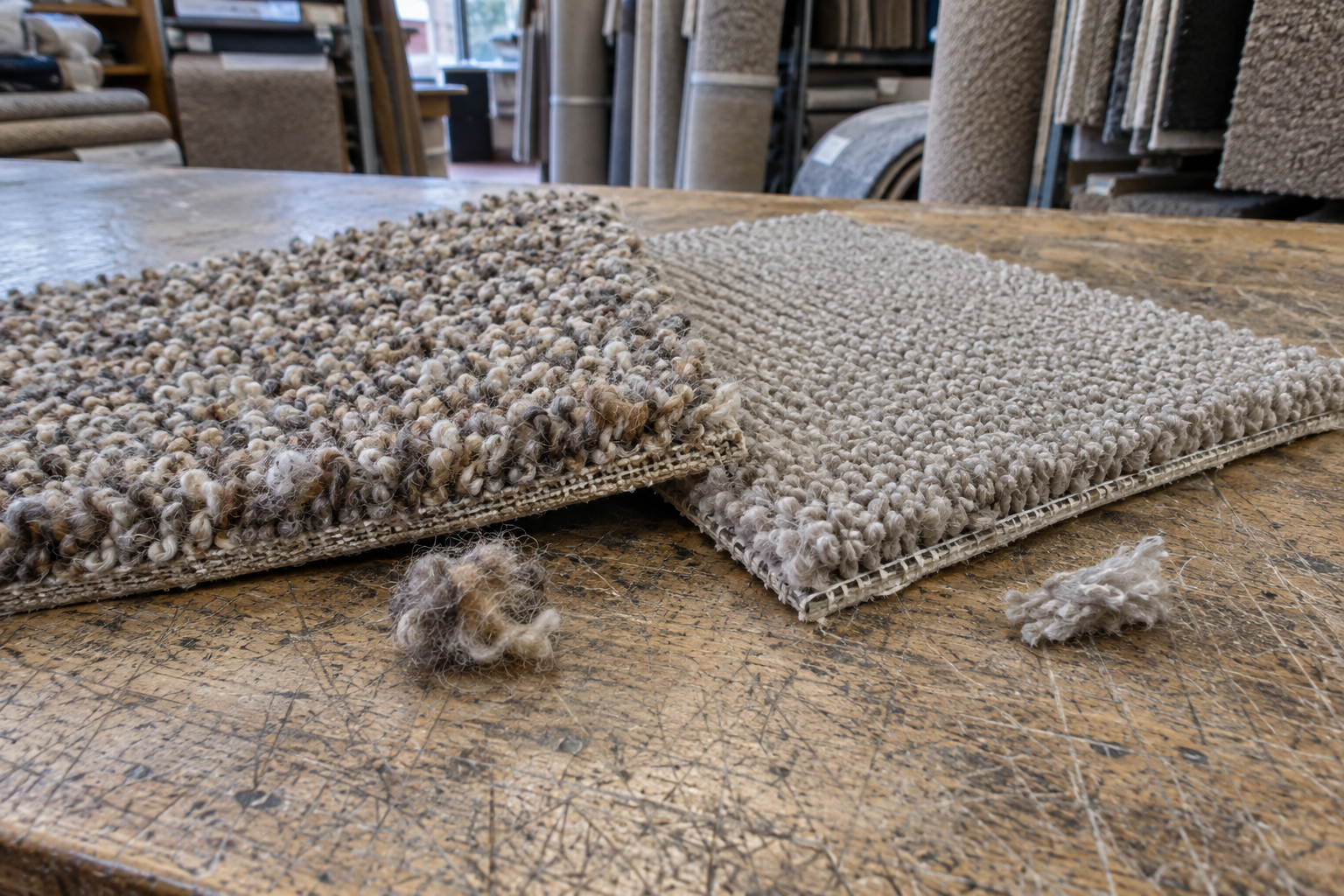
Natural fibre does not mean maintenance-free. Follow the maker's vacuuming and stain instructions, deal with moth activity, and expect some initial shedding where the manufacturer describes it as normal.
Why choose polypropylene?
Polypropylene is inherently stain resistant and widely used in easy-clean domestic carpets. Many ranges permit cleaning with a correctly diluted bleach solution, but that permission belongs to the exact carpet and must not be transferred to wool or another product.
Polypropylene can appear as twist, Saxony and loop carpet. The fibre name does not tell you pile depth, softness or use rating.
What does an 80/20 wool blend mean?
An 80/20 carpet normally combines 80% wool with 20% supporting fibres, often to balance wool's character with construction and wear needs. Other blends use different percentages and fibres.
Treat the stated pile content as one part of the specification. A blend is not automatically better than a pure-wool or synthetic carpet for every household.
Pets, spills and busy rooms
For frequent spills, begin with carpets whose manufacturer explicitly supports the required cleaning method. For pets, consider cut pile to reduce snagging risk and check how visible hair will be against the colour.
For stairs and hallways, prioritise the exact heavy-use and stair suitability rating. Both wool and polypropylene ranges can meet demanding domestic needs.
Cost and lifetime value
Compare the delivered carpet quantity, fitting, underlay and accessories as one job. A lower square-metre price may not give the best value if the carpet is unsuitable for the room. Equally, a premium fibre does not remove the need for correct fitting and care.
Final checks before ordering
- Confirm the exact product name, construction, colour and selected width or length.
- Read the current manufacturer specification, room-suitability information, fitting method and warranty conditions.
- Measure the physical layout rather than relying only on square metres, and ask the fitter to approve quantities and joins.
- Check the subfloor, doors, transitions, stairs and any underfloor-heating requirements.
- Review the current CFS product page for delivery coverage, pack sizes and selectable options before payment.
Keep the sample and order confirmation until fitting is complete. Product photographs are useful for recognition, but screens and lighting can change colour. Where the retailer page, a general guide and the exact manufacturer's instructions differ, obtain confirmation for the product being installed.
Shop Wool and Synthetic Carpets
Frequently asked questions
Is wool carpet better than polypropylene?
Wool offers natural resilience and feel; polypropylene offers practical stain resistance and easy-clean choices. The better option depends on the exact product and household.
Can polypropylene carpet be cleaned with bleach?
Many ranges can, but only use the concentration and method stated by that carpet's manufacturer. Never assume the same treatment is safe for wool.
Is wool carpet suitable for stairs?
Some wool and wool-blend products are rated for stairs and heavy traffic. Check the individual product rather than the fibre alone.
Which carpet is best for pets?
A stain-resistant cut-pile carpet carrying the appropriate use rating is a sensible starting point. Cleaning instructions and colour are also important.
Sources and further guidance
Product ranges and specifications can change. Confirm the current product page and manufacturer instructions before ordering.