

Written by the Carpet Flooring Supplies team
Practical buying guidance based on current manufacturer information and our experience supplying flooring products.
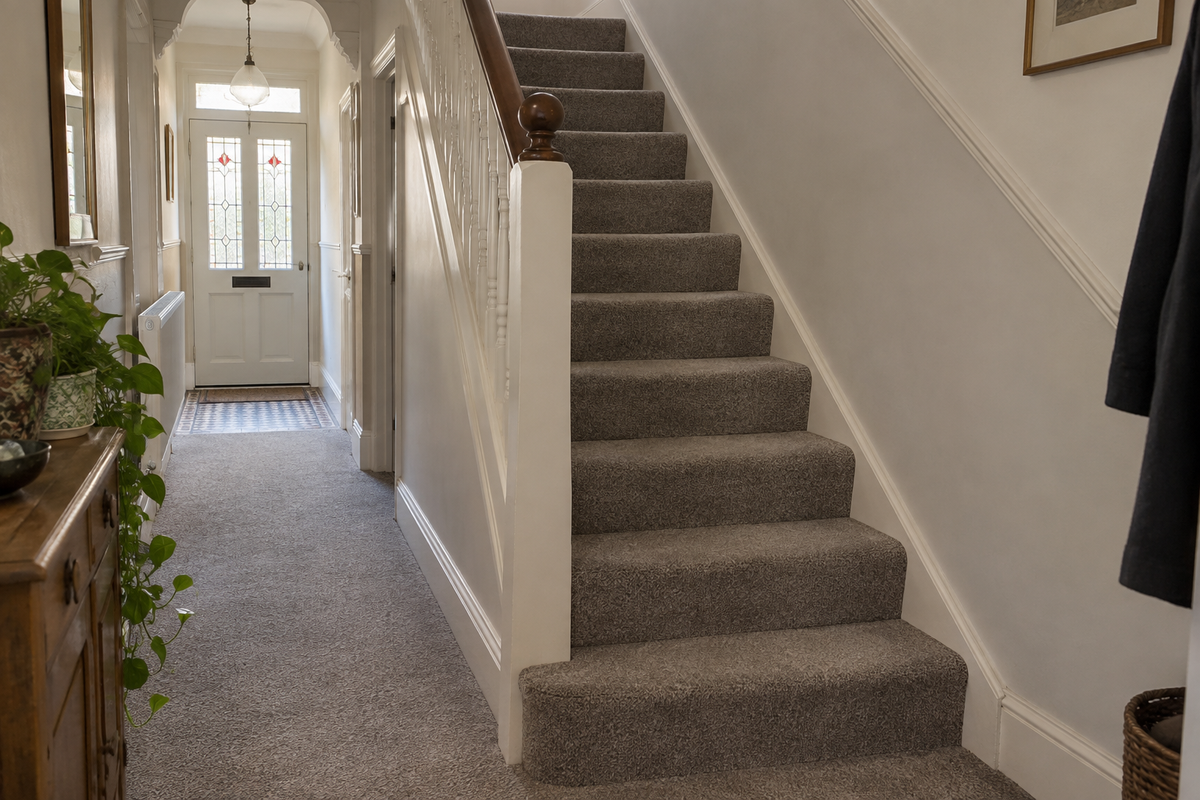
For stairs and hallways, prioritise a carpet explicitly rated for the expected traffic and approved for stairs. Dense twist, suitable loop and other heavy-domestic constructions can all work. Maximum pile depth is not the target; recovery, secure fitting and a practical colour matter more.
Quick comparison
| Situation | Starting point | Check before ordering |
|---|---|---|
| Busy family stairs | Heavy-domestic carpet approved for stairs | Check cleaning, pile recovery and fitting |
| Entrance hallway | Dense easy-care carpet | Account for grit, moisture and direct outdoor traffic |
| Runner | Carpet suitable for the runner installation | Edges, turns and pattern alignment need planning |
| Pets | Suitable cut pile | Loop pile may snag on claws |
Why stairs are demanding
Feet land and turn at the nosing, loading the same narrow areas repeatedly. Hallways also funnel people along a fixed route. A carpet that performs well in a quiet bedroom is not automatically suitable.
Check the exact manufacturer's room suitability and use classification. Cormar and Abingdon both publish stair and heavy-domestic suitability for specific ranges rather than for every carpet in a style.
Which pile works best?
A dense twist is a strong all-round starting point because its textured cut pile can combine recovery with a practical appearance. Suitable wool loop can perform well and create a tailored runner look, but exposed loops may catch pet claws.
Deep Saxony is not automatically excluded: some products are rated for stairs. Expect deeper pile to show compression or tracking more readily and rely on the product rating rather than appearance.
Colour and pattern
Very light plain carpet shows grit near entrances; very dark plains can show lint and pale fibres. Mid-tones, heathers, flecks and restrained patterns often conceal day-to-day marks.
For stripes or a runner, agree the direction, centring and pattern repeat with the fitter before ordering. Winders and turns require extra planning.
Underlay and gripper
Use underlay recommended for concentrated traffic and compatible with the carpet. Dense crumb rubber or a heavy-use high-density alternative can be a good starting point; our stair-underlay guide compares them.
Gripper layout, seams and tension are safety-critical on stairs. Follow the product instructions and use an experienced fitter.
Measure professionally
A straight flight still includes tread depth, riser height, width, nosings and the landing. Winders, split landings and runners add layout constraints. Obtain a fitter's cutting plan before placing a supply-only order.
Final checks before ordering
- Confirm the exact product name, construction, colour and selected width or length.
- Read the current manufacturer specification, room-suitability information, fitting method and warranty conditions.
- Measure the physical layout rather than relying only on square metres, and ask the fitter to approve quantities and joins.
- Check the subfloor, doors, transitions, stairs and any underfloor-heating requirements.
- Review the current CFS product page for delivery coverage, pack sizes and selectable options before payment.
Keep the sample and order confirmation until fitting is complete. Product photographs are useful for recognition, but screens and lighting can change colour. Where the retailer page, a general guide and the exact manufacturer's instructions differ, obtain confirmation for the product being installed.
Shop Carpets for Stairs and Hallways
Frequently asked questions
Is twist carpet best for stairs?
It is a practical starting point, but the exact stair and heavy-use rating is decisive. Suitable loop and other cut-pile carpets can also work.
Can Saxony carpet go on stairs?
Only when the manufacturer rates that range for stairs and the fitter approves the construction. Depth alone cannot decide.
What colour carpet is best for a hallway?
Mid-tone or heathered colours tend to hide routine marks better. Test them beside the entrance and in your lighting.
Do stairs need special underlay?
They need an underlay suitable for concentrated traffic and compatible with the carpet and fitting method. Purpose-rated dense products are useful starting points.
Sources and further guidance
Product ranges and specifications can change. Confirm the current product page and manufacturer instructions before ordering.