
Written by the Carpet Flooring Supplies team
Practical buying guidance based on current manufacturer specifications and our experience supplying carpet underlay nationwide.
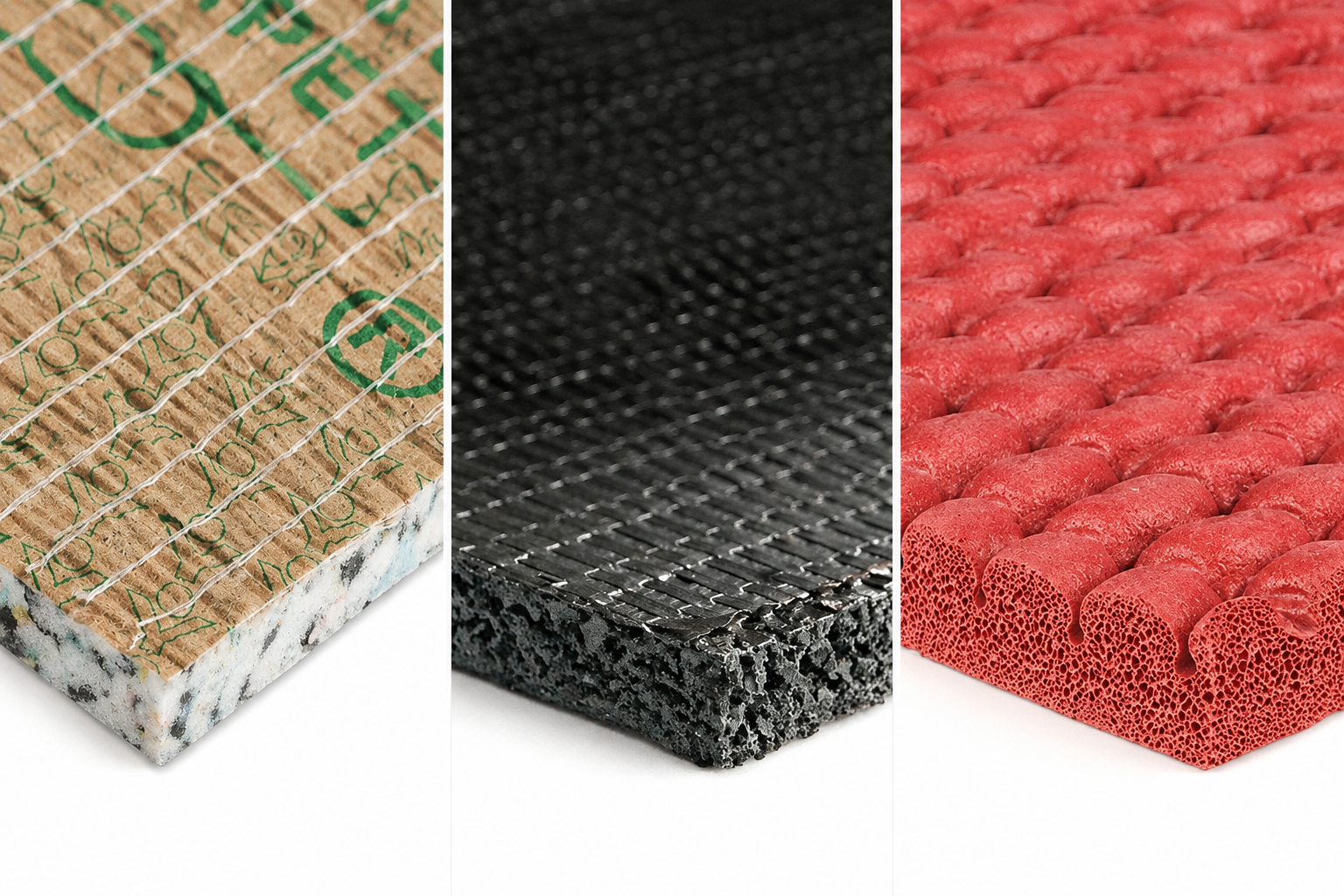
PU foam is usually the easier choice for light handling and a wide range of comfort options. Dense crumb rubber is a strong starting point for stairs, hallways and heavy furniture. Sponge rubber is a separate construction, with products ranging from springy domestic underlay to specialist low-tog options.
The best material depends on the room and the individual product. A high-density PU underlay can be rated for heavy use, while a rubber underlay may be designed for a particular carpet or fitting system. Check the use classification, density, thickness, tog, sound rating and installation method before deciding.
PU foam, crumb rubber and sponge rubber compared
These are useful starting points. The specification of the exact product takes priority over the general characteristics of its material.
On a small screen, scroll the comparison table sideways.
| What matters | PU foam | Crumb rubber | Sponge rubber |
|---|---|---|---|
| Construction | Polyurethane foam; rebond products combine foam pieces | Rubber granules bound into a dense sheet | Cellular rubber, available in flat or profiled constructions |
| Typical feel | Cushioned, with firmer high-density grades available | Firm and supportive | Springy, with feel varying by profile and grade |
| Handling | Generally lighter and easier to manoeuvre | Dense rolls can be heavy | Often heavier than PU; check the roll weight |
| Where to start | Bedrooms and lounges; approved high-density grades for heavier use | Stairs, landings, hallways and heavy furniture, where rated | Domestic comfort or specialist applications, depending on the product |
| Heating and sound | Wide choice of tog and impact-sound figures | Check the figures; firmness does not establish thermal or acoustic performance | Includes low-tog products, but rubber alone does not mean UFH approval |
What is PU foam carpet underlay?
PU stands for polyurethane. Rebond PU underlay uses pieces of foam combined into a sheet. Its comparatively light handling and choice of cushioning levels make it a practical option for many homes.
Do not confuse a soft feel with a low specification, or a thick roll with a strong one. PU products vary considerably in density and intended use. If you want comfortable support in a bedroom, you may choose differently from someone buying for a busy landing.
Tredaire Chromium shows why foam should not be dismissed for demanding areas. It is a 9mm PU underlay with a published density of 180kg/m³, and its manufacturer classifies it for heavy contract use with stretch-fit carpet installation.
What is the difference between crumb and sponge rubber?
Crumb rubber: dense support
Crumb rubber is made from rubber granules bound together. It generally provides a firm base, making appropriately rated products useful where traffic is concentrated or furniture is heavy.
Tredaire Treadmore is a good example. Interfloor specifically recommends it for stairs, landings, heavy furniture and high foot traffic. Its 7.95mm thickness and 390kg/m³ density give it a different construction from a deep, soft foam.
Shop crumb-rubber underlay for dense support, then check the product's room and fitting suitability.
Sponge rubber: a separate cellular construction
Sponge rubber contains cells that compress under load. Flat and waffle-profile products offer different feels, and the category includes both comfort-focused and specialist underlays. It should not be treated as another name for crumb rubber.
Duralay Heatflow Carpet is a specialist example: a 6.1mm sponge-rubber carpet underlay with a low 0.75 tog rating. Its purpose is to limit resistance to heat passing from a compatible underfloor-heating system.
Heatflow Carpet is not recommended for electric mat or dry underfloor-heating systems. Confirm the complete floor construction with the heating and carpet manufacturers before ordering.
Shop sponge-rubber underlay and compare the specific comfort, thermal and fitting requirements.
Three products, three different starting points
These products are available through Carpet Flooring Supplies. Their published specifications help explain the differences; the table is not a ranking of every underlay in each material.
On a small screen, scroll the product table sideways.
| Specification | Tredaire Chromium | Tredaire Treadmore | Duralay Heatflow Carpet |
|---|---|---|---|
| Material | PU foam | Crumb rubber | Sponge rubber |
| Thickness | 9mm | 7.95mm | 6.1mm |
| Density | 180kg/m³ | 390kg/m³ | 495kg/m³ |
| Published impact-sound reduction | 42dB | 32dB | 31dB |
| Nominal roll area | 15.07m² | 10.96m² | 10.00m² |
| Installation | Stretch fit | Stretch fit | Stretch fit |
| Useful starting point | High-density PU for comfort and heavy use | Firm support for stairs and concentrated traffic | Low-tog carpet installation over compatible UFH; excludes electric mat/dry systems |
Technical references: Interfloor Chromium, Treadmore and Heatflow Carpet. The product pages link to the manufacturer's technical sheets.
Which is more comfortable, and which lasts longer?
PU foam often appeals if you want cushioning without a heavy roll. Sponge rubber can provide a springy feel, while crumb rubber tends towards firmer support. The carpet above it also affects the finished feel, so a bare underlay sample cannot tell the whole story.
For durability, look at the manufacturer's use classification and recovery information. Density describes mass per unit volume; it is not a universal quality score across different materials. A 390kg/m³ crumb rubber and a 180kg/m³ PU product cannot be ranked simply by dividing those figures.
Likewise, no material has a guaranteed lifespan in every room. Concentrated traffic, furniture loads, the carpet and correct fitting all affect the result. Our 8mm vs 10mm vs 12mm underlay guide explains how thickness fits into that decision.
Which should you choose for your room?
Bedrooms and lounges
Start with a domestic PU or sponge-rubber product that provides the feel you want. Then check the carpet's requirements, door clearance and finished height at adjoining floors. A warmer, cushioned option can suit an unheated floor; a heated room needs a separate tog check.
Stairs, hallways and heavy furniture
Prioritise firm support and recovery under repeated use. Treadmore has an explicit manufacturer recommendation for these areas. A high-density PU product such as Chromium can also be suitable when the carpet and fitting requirements agree; rubber does not win automatically.
Read our best underlay for stairs and hallways guide for the full comparison. Stairs need a fitter's assessment of the carpet, support and installation, not just a preferred thickness.
Rooms with underfloor heating
Choose a product specifically approved for the system. Tog measures thermal resistance: a higher figure resists heat flow more strongly. That can be useful above an unheated floor but works against heat travelling upwards from a heated floor.
Chromium's published 2.26 tog is much higher than Heatflow Carpet's 0.75 tog. Those figures describe thermal performance, not overall quality. Add the carpet, underlay and any other required layer's thermal resistance, then compare the total with the heating-system limit. Follow Heatflow Carpet's electric mat/dry-system exclusion as well as the tog requirement.
Browse underfloor-heating underlay once the system requirements are clear. The Heatflow Carpet technical sheet sets out its intended use and restriction.
Is foam or rubber better for reducing noise?
Compare published impact-sound results for the exact products. The technical sheets for the three examples above report impact-sound reduction as ΔLw under stated test standards. These figures concern impacts such as footsteps; they are not promises that every sound in your home will become that many decibels quieter.
Carpet, floor structure, ceiling and fitting all affect the result. A higher laboratory figure does not guarantee the same improvement in your building, and underlay alone cannot make a room completely soundproof. Choose a product that suits the room first, then compare acoustic performance on the same test basis.
Check fitting and total quantity before ordering
All three named products specify stretch-fit carpet installation. In this method, the carpet is stretched over the underlay and held by gripper. A double-stick installation uses adhesives and needs products approved for that system; do not substitute one method for another.
Ask your fitter to confirm compatibility, seam layout, finished height and quantities before buying. Underlay cannot correct an unsound or damp subfloor.
Compare the cost of the whole order, including delivery and the number of full rolls needed. Chromium, Treadmore and Heatflow Carpet have different roll areas, so the cheapest roll is not necessarily the cheapest way to cover the room. Plan the strips and offcuts as well as the total square metres.
Carpet Flooring Supplies sells online for nationwide delivery on a supply-only basis. Measuring and fitting should be arranged separately.
Our practical recommendation
- For comfort and easier handling: start with a suitable PU foam grade.
- For stairs, hallways or heavy furniture: compare dense crumb rubber with high-density alternatives explicitly rated for the use.
- For a springy rubber feel or a specialist installation: check the sponge-rubber range product by product.
- For underfloor heating: use an approved low-tog product and confirm the complete floor construction.
Choose the specification that meets the room's needs, then compare feel and total delivered cost. Material helps you make a shortlist; it should not make the whole decision.
Browse PU foam, crumb rubber and sponge rubber, or view all carpet underlay.
Frequently asked questions
Is rubber underlay better than foam?
It depends on the product and room. Dense crumb rubber can provide firm support for concentrated traffic, while PU offers many comfort grades and easier handling. Suitable high-density PU and sponge-rubber products can also serve demanding areas.
Can PU foam underlay be used on stairs?
Yes, if the exact product is rated for the use and compatible with the carpet and installation. Chromium is one high-density PU example suitable for use throughout the home. Do not assume every soft bedroom foam has the same specification.
Is sponge rubber the same as crumb rubber?
No. Sponge rubber has a cellular structure; crumb rubber is made from bound granules. They have different constructions and ranges of intended use, so compare the named products separately.
Does higher density mean better underlay?
Density is useful information, particularly within similar constructions, but it is not a quality grade. Check the intended use, recovery, carpet compatibility, thickness and thermal requirements alongside it.
Is all rubber underlay suitable for underfloor heating?
No. The specific underlay must be approved for the system and the complete floor must stay within its thermal-resistance limit. Even a low-tog product can have restrictions: Heatflow Carpet is not recommended for electric mat or dry systems.
Will foam or rubber underlay soundproof a room?
Neither can guarantee complete soundproofing. A suitable underlay can reduce impact noise through a carpeted floor. Compare like-for-like test results and consider the wider floor construction if noise is a major concern.