

Written by the Carpet Flooring Supplies team
Practical buying guidance based on current manufacturer specifications and our experience supplying carpet underlay nationwide.
The best carpet underlay for underfloor heating is a low-tog product approved for your exact heating system, carpet and fitting method. Check the whole floor construction before choosing a roll: a suitable underlay cannot make an unsuitable carpet or installation work.
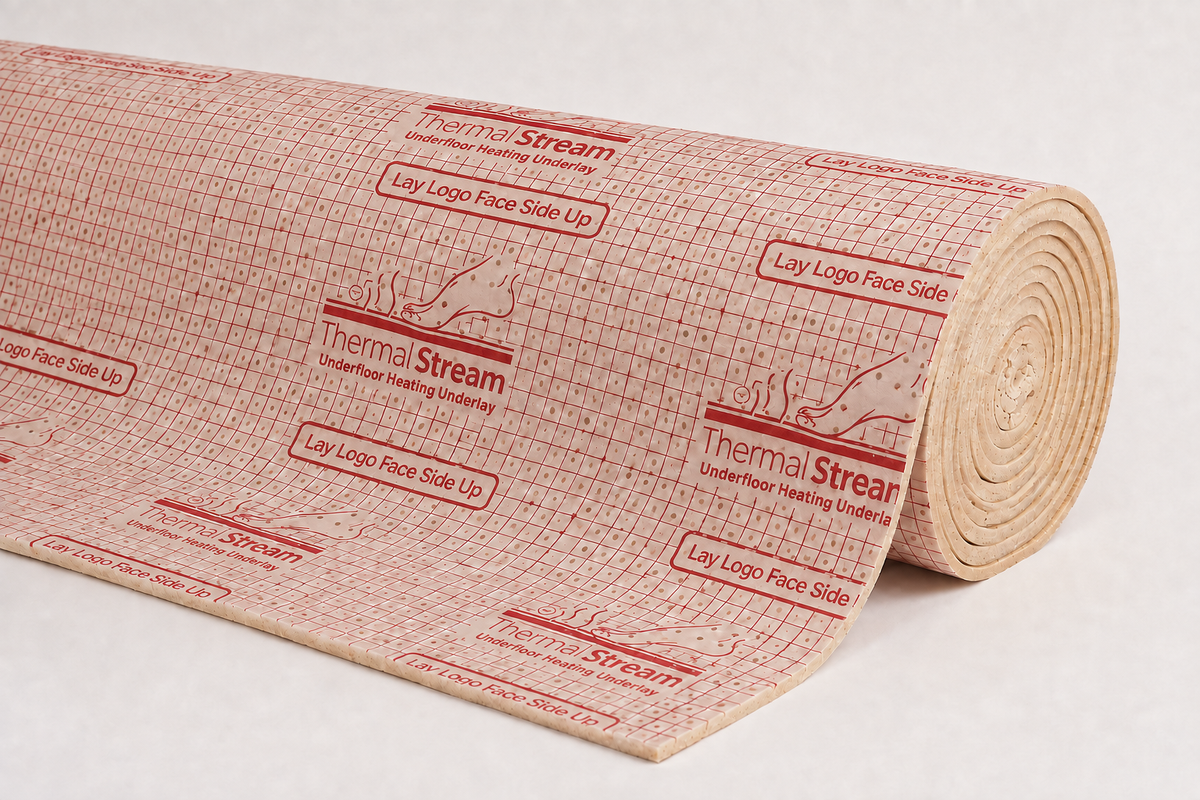
For a compatible installation, Duralay Heatflow Carpet is one option sold by Carpet Flooring Supplies. It has a published 0.75 tog rating, but its manufacturer does not recommend it for electric mat or dry underfloor-heating systems. That restriction matters just as much as the low tog.
What to check before choosing an underlay
On a small screen, scroll the comparison table sideways.
| Check | Information you need | Why it matters |
|---|---|---|
| Heating system | Manufacturer, model and specified floor layers | Water, foil and embedded electric systems can have different requirements |
| Carpet | Published tog, backing and UFH approval | The carpet adds thermal resistance and must suit the installation |
| Underlay | Low tog, explicit system compatibility and fitting method | Low thermal resistance alone does not establish suitability |
| Other layers | Required overlay or boards and their thermal resistance | They can use part of the permitted resistance above the heater |
| Completed floor | Combined resistance, heat output and temperature limits | Passing a tog check does not prove that the room will receive enough heat |
Why does underfloor heating need low-tog underlay?
Tog measures resistance to heat flow. Higher-tog underlay can help retain room heat above an unheated floor. With underfloor heating, warmth needs to pass upwards through the flooring, so lower resistance is usually preferable.
This changes the buying priority. The warmest insulating underlay is not necessarily the most comfortable choice once a heater sits below it. Choose a compatible product that lets the heating design work, then compare its support, thickness and impact-sound performance.
Interfloor's carpet guidance suggests an underlay target of 0.8 tog or less. That is a product-selection target, not an allowance for the complete floor or approval for every heating system. Our underlay tog ratings guide explains the distinction.
What combined tog is allowed?
Use the limit for the exact system and floor construction. Do not assume that a figure on a retailer's page applies to every installation.
For example, Nu-Heat's carpet guidance gives a maximum combined carpet-and-underlay value of 2.5 tog, preferably below 1.5 tog with a heat pump. Other systems and constructions can specify different limits. Where published guidance and the supplied system instructions differ, ask the system manufacturer to confirm the permitted combination before ordering.
For an ordinary arrangement with both carpet and underlay above the heating, begin with:
Carpet tog + underlay tog = combined tog
Add any overlay or other layer above the heater that the system instructions require you to count. Do not confuse insulation beneath a heating element with carpet underlay above it: their positions and jobs differ.
A worked example
Suppose your carpet is 1.2 tog and the underlay is 0.75 tog, with no additional layer to count:
1.2 + 0.75 = 1.95 tog
That total is below a hypothetical 2.5-tog limit but above a hypothetical 1.5-tog limit. It therefore passes only the first numerical check. You would still need product approval, the correct fitting method and sufficient heat output. These numbers demonstrate the calculation; they do not approve a particular installation.
Duralay Heatflow Carpet: a low-tog example
Duralay Heatflow Carpet is a sponge-rubber underlay designed for carpet installations over compatible underfloor heating. CFS and Interfloor publish these specifications:
- 0.75 tog thermal resistance;
- 6.1mm thickness;
- 10m² nominal roll area;
- stretch-fit carpet installation;
- 31dB published impact-sound reduction.
Do not choose it for an electric mat or dry underfloor-heating system. Interfloor's Heatflow Carpet technical sheet explicitly excludes recommending that use. Check compatibility with the complete heating and carpet specification even where the system is water-based.
The 31dB figure is a laboratory impact-sound result. It does not guarantee a 31dB reduction in every room or complete soundproofing. If noise is a priority, compare suitable low-tog products on the same test basis; our acoustic underlay guide explains the limitations.
Does water or electric heating change the choice?
Yes, but the broad label is only the start. Record the model and whether the heating is embedded in a floor or laid near the surface. A product approved for one construction may be unsuitable for another.
Electric foil systems can use a specified insulating layer beneath the heater and a protective overlay above it. Warmup describes that arrangement in its Foil Heater guidance. Those components are not interchangeable with an ordinary carpet-underlay roll.
Give your fitter and heating specialist the complete specification. They should confirm the carpet, any carpet underlay, the required overlay and the heating controls together. A low-tog label is not permission to alter the manufacturer's arrangement.
Can ordinary PU foam underlay be used?
Only if the exact product is approved and the full construction meets the system requirements. Many PU products are designed to resist heat loss, which can be useful in an unheated room but restrict heat transfer from below.
Do not generalise from material alone. Specialist foam products and specialist rubber products have their own intended uses. Compare their technical sheets, rather than assuming all foam is unsuitable or all rubber is suitable. Read PU foam vs rubber carpet underlay for the material differences.
Thickness is also an unreliable shortcut. A thinner product can still have the wrong thermal resistance or fitting specification. Our underlay thickness comparison explains why depth is only one consideration.
Five checks before you order
- Confirm the room's heat requirement. If carpet replaces a hard floor, ask the heating designer to check the effect on available heat output.
- Obtain the carpet specification. Check its tog, backing, maximum operating temperature and approval for that heating construction.
- Agree the fitting method. Plan gripper and fixings around heating components, and use only approved overlays and adhesives where required.
- Follow the commissioning instructions. Drying, start-up and temperature-control requirements depend on the system and floor materials.
- Confirm quantities. Use the chosen roll's coverage and a workable cut plan. Our underlay roll calculator guide explains the calculation.
Carpet Flooring Supplies supplies products online for nationwide delivery. Measuring, fitting and heating-system design should be arranged separately. Once the specification is agreed, compare the underfloor-heating underlay range and order the approved product.
Frequently asked questions
What tog underlay is best for underfloor heating?
A low-tog underlay approved for your system. Interfloor suggests 0.8 tog or less for the underlay in carpet installations, but the carpet and other relevant layers must also fit within the system's combined limit.
Is 1 tog underlay suitable?
Possibly, where the exact product is approved and the complete construction meets the heating specification. It leaves less thermal allowance for the carpet than a lower-tog product. Do the combined calculation before buying.
Is Heatflow Carpet suitable for all UFH systems?
No. It is not recommended for electric mat or dry underfloor-heating systems. Its low tog does not override that restriction or the need for compatibility with the carpet and installation method.
Can thick carpet go over underfloor heating?
Only when the carpet is approved and the full thermal resistance and temperature limits are acceptable. Check the published tog and system design rather than judging by appearance or pile depth.
Will low-tog underlay guarantee a warm room?
No. It can help heat pass through the floor, but room heat loss, available heated area, floor construction and controls also affect performance. A heating designer must check that the system can meet the room's demand.
Where should I start if I do not know my heating specification?
Find the installation documents and identify the manufacturer and model. Ask the heating supplier to confirm the floor requirements before ordering. For the wider buying decision, use our carpet-underlay buying guide.