

Written by the Carpet Flooring Supplies team
Practical buying guidance based on current manufacturer specifications and our experience supplying carpet underlay nationwide.
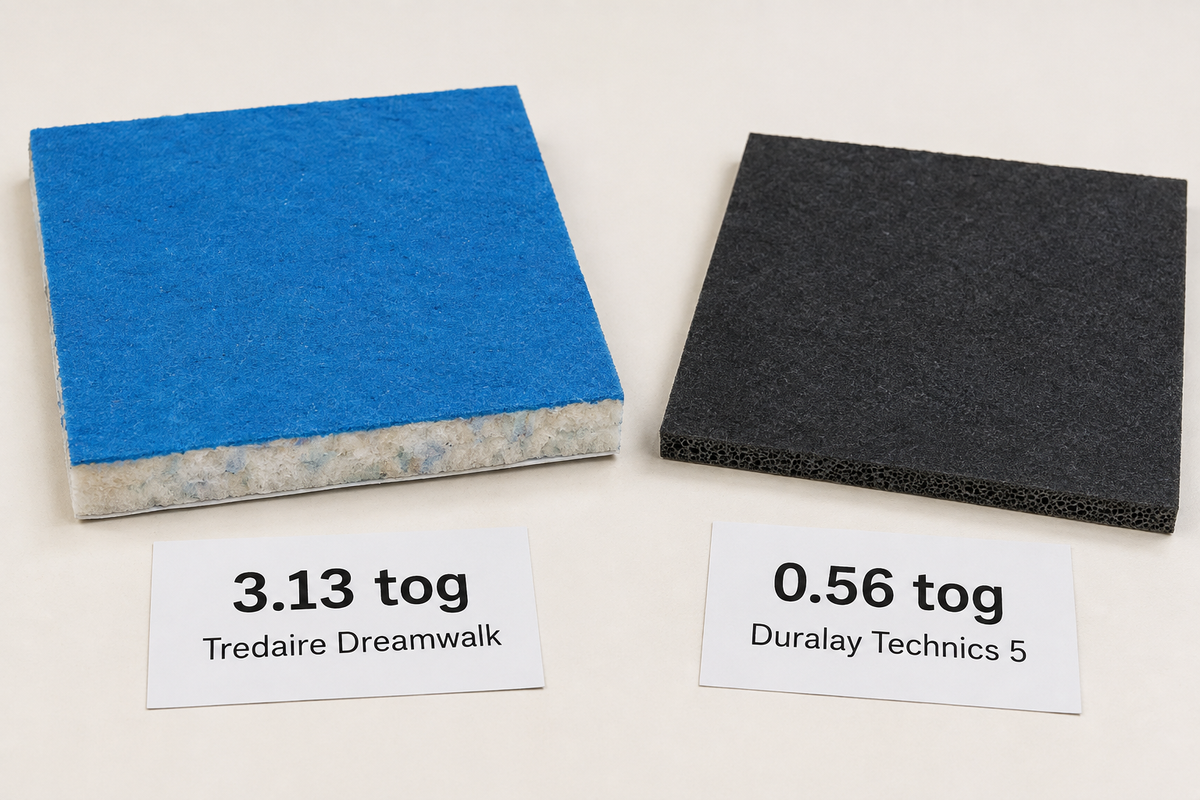
Underlay tog measures thermal resistance: how strongly the material resists heat passing through it. Higher tog can help retain room heat above an unheated floor. Lower tog lets underfloor heating transfer warmth upwards more readily.
Tog does not measure quality, softness, durability or heating power. A 3.1-tog luxury underlay and a 0.75-tog specialist product can both be good choices for the jobs they are designed to do.
Is high or low tog better?
On a small screen, scroll the comparison table sideways.
| Your situation | Useful direction | Keep in mind |
|---|---|---|
| Unheated floor; retaining room heat is a priority | Compare higher-tog products suitable for the room | Underlay does not replace building insulation or repair draughts and damp |
| Underfloor heating | Choose an approved low-tog product | The carpet and other relevant layers share the system's permitted thermal resistance |
| Stairs or concentrated traffic | Confirm support, recovery and room-use rating first | Tog does not tell you whether the underlay can cope with the traffic |
| Impact noise is the main concern | Compare relevant acoustic test results among suitable products | Tog is a thermal figure, not a sound-reduction rating |
Real examples of underlay tog ratings
These products illustrate different thermal priorities. The figures are published by both CFS and the manufacturer; choose on the complete specification, not tog alone.
| Product | Tog | Thickness | Thermal role |
|---|---|---|---|
| Cloud 9 Cumulus | 3.1 | 11mm | High thermal resistance in a luxury PU underlay |
| Tredaire Chromium | 2.26 | 9mm | Insulating PU with a high-density, heavy-use specification |
| Duralay Heatflow Carpet | 0.75 | 6.1mm | Low-tog sponge rubber for compatible UFH; not recommended for electric mat/dry systems |
Manufacturer references: Ball & Young Cumulus, Interfloor Chromium and Heatflow Carpet.
Cumulus resists heat flow more strongly than Heatflow Carpet. That is useful information about insulation; it does not mean Cumulus is a better underlay for a heated floor. Likewise, Heatflow's low tog is a deliberate feature, not evidence of poor quality.
Can you work out tog from thickness?
No. Thickness affects the distance heat travels, but material and construction also influence thermal resistance. Two underlays of the same depth can have different tog ratings.
Use the manufacturer's figure for the exact product. Do not estimate it from colour, weight, density, thickness or how warm a sample feels in your hand. Read our 8mm vs 10mm vs 12mm comparison and PU foam vs rubber guide to compare those other characteristics.
How to calculate combined tog
When assessing flooring above underfloor heating, add the thermal resistance of the layers that the heating instructions require you to count. For a carpet and underlay above the heat source:
Carpet tog + underlay tog = combined tog
Include an overlay or another prescribed layer above the heater where applicable. Keep the actual layer order in view: some systems also have an insulating underlay beneath the heater, serving a different purpose.
Example 1: a low-tog underlay
Assume a carpet rated at 1.0 tog and an underlay rated at 0.75 tog, with no other layer to count:
1.0 + 0.75 = 1.75 tog
This would be below a hypothetical 2.5-tog limit but above a hypothetical 1.5-tog limit. Passing the arithmetic is only one check; the carpet, underlay and fitting arrangement must also be approved.
Example 2: an insulating underlay
Assume a 1.4-tog carpet combined with a 2.26-tog underlay:
1.4 + 2.26 = 3.66 tog
That would exceed both illustrative limits. The carpet layer cannot be ignored because the underlay happens to fall below one of them on its own.
You can also calculate the remaining allowance
Suppose your confirmed system limit is 2.5 tog, the chosen carpet is 1.6 tog and no other layer needs to be counted:
2.5 − 1.6 = 0.9 tog available for the underlay
A 0.75-tog product would fit that numerical allowance. It would still need explicit approval for the heating system and carpet. If an overlay must also be included, subtract its resistance too.
Is the maximum always 2.5 tog?
No. The permitted total belongs to the heating specification, not to carpet underlay as a whole. System designs can set different limits and count different combinations of layers.
Nu-Heat's carpet guidance, for example, gives 2.5 tog for carpet and underlay together, preferably below 1.5 with a heat pump. Those figures should not be applied automatically to a different manufacturer's electric or water system.
Obtain the instructions for your actual installation. If the product page, generic guide and system manual do not agree, ask the manufacturer to confirm the limit and permitted layers before buying.
For Heatflow Carpet specifically, the manufacturer's technical sheet says it is not recommended for electric mat or dry systems. A low numerical total does not override that restriction. Our underfloor-heating underlay guide explains the wider compatibility checks.
What tog should you choose for a cold room?
If there is no underfloor heating, a higher-tog underlay can help resist heat loss through the carpeted floor. Start with products that meet the carpet, room-use and fitting requirements, then compare their thermal resistance.
There is no tog threshold that guarantees a warm room. A cold draught, damp subfloor or poorly insulated building needs attention in its own right. Underlay is one part of the floor; it cannot make the rest of the building's heat loss disappear.
A bedroom and a busy stairway can legitimately need different products. For the stairs, firm support and recovery still matter even if warmth is important. Use our stairs and hallways guide before choosing the highest tog available.
Does a high tog rating mean lower energy bills?
A tog figure describes the product's thermal resistance. It does not tell you the percentage change in a household's energy bill. The floor area, construction, temperature difference, controls and heat loss elsewhere all affect the result.
Use tog to compare suitable products. Avoid treating a difference in tog as the same percentage difference in running costs. Over underfloor heating, a high-tog finish can make it harder for the system to transfer heat into the room.
Our practical recommendation
- For an unheated floor: compare higher-tog options when reducing heat loss is a priority, after checking room suitability.
- For underfloor heating: choose an approved low-tog product and calculate the complete permitted construction.
- For either: compare support, thickness, acoustic results, installation method and full-roll quantities alongside tog.
For noise questions, read our acoustic underlay guide. For the overall room-by-room decision, start with Which carpet underlay do I need?
Carpet Flooring Supplies sells online for nationwide delivery on a supply-only basis. Agree measuring, fitting and any heating-system requirements with the relevant installer before ordering.
Frequently asked questions
What exactly does tog measure?
Thermal resistance. A higher number means greater resistance to heat passing through the material. It is separate from thickness, density, softness and sound reduction.
What is a good tog rating for carpet underlay?
The right value depends on the floor. Higher tog can suit an unheated floor where retaining heat matters; underfloor heating needs an approved low-tog product within the system's combined allowance.
Do you add carpet and underlay tog together?
Yes, when both sit above the heating and form part of the system's specified thermal calculation. Include any overlay or other layer the heating manufacturer requires you to count.
Will low-tog underlay feel cold?
Low tog does not mean the product generates cold. It means heat passes through it more readily. That is useful above compatible underfloor heating; it provides less insulation than a higher-tog option over an unheated floor.
Can I reuse old underlay if I do not know its tog?
Do not assume it is suitable for a heated floor. Identify the exact product and its specification, and check its condition and carpet compatibility. Our underlay reuse guide covers the other checks.