

Written by the Carpet Flooring Supplies team
Practical buying guidance based on manufacturer specifications and our experience supplying carpet underlay nationwide.
For an initial underlay estimate, calculate the floor area in square metres, add an allowance for cutting, divide by the exact roll coverage and round up to whole rolls. Then check that the physical roll dimensions will produce the pieces you need.
A roll with enough total area can still leave you short if its offcuts do not fit the room. Start with the arithmetic, then confirm the strip layout with your fitter before ordering.
Underlay roll calculator
Full rolls = floor area × (1 + allowance percentage ÷ 100) ÷ roll coverage, rounded up.
For a rectangular room, floor area is length × width in metres. For several rooms using the same underlay, add their areas before applying the allowance. Use the exact coverage stated on the chosen product.
This is an area estimate. It does not plan cuts, stairs, seams or offcuts. The worked examples below show how to check the result.
Five per cent is an illustrative starting allowance for a straightforward rectangle. It is not a manufacturer rule or a guarantee of enough material. A shaped room, staircase or inefficient strip layout may need more; your fitter should set the allowance for the actual job.
Worked example: one rectangular room
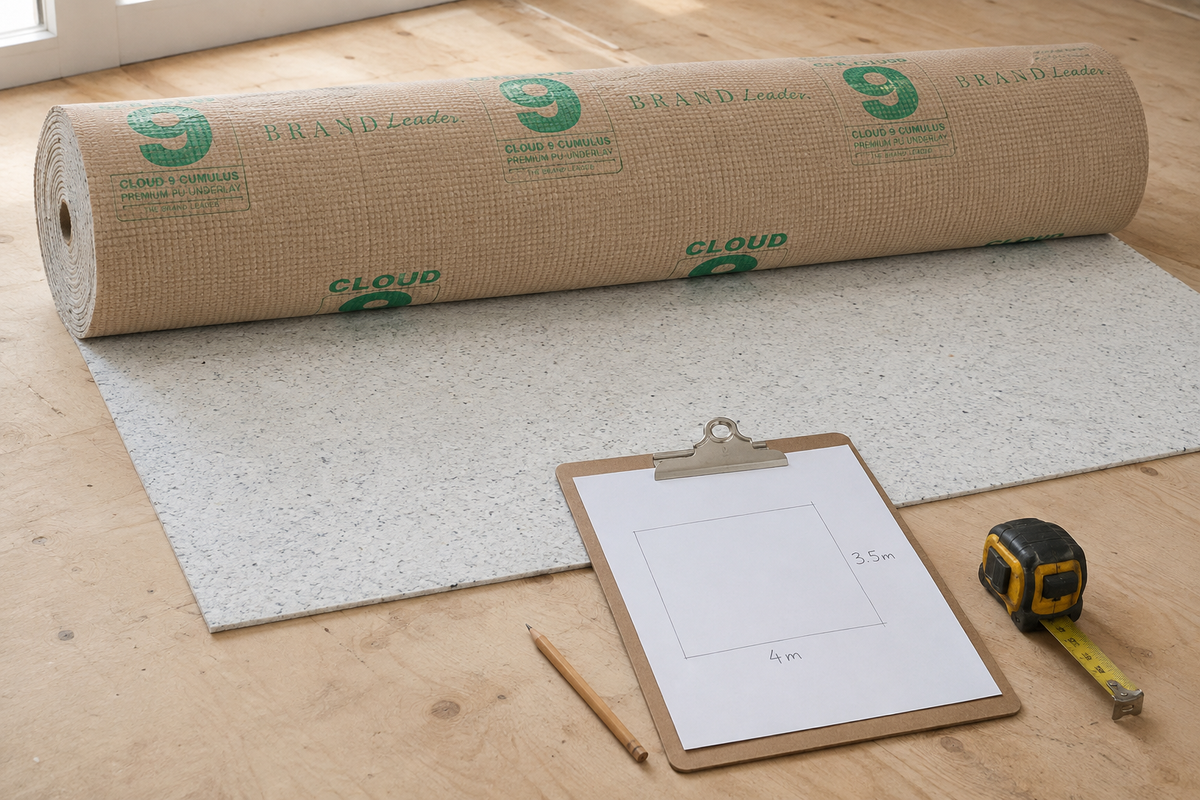
The measured floor is 4.00m × 3.50m = 14.00m². With an illustrative 5% allowance:
14.00 × 1.05 = 14.70m²
If the chosen roll covers 15.07m², the calculation is 14.70 ÷ 15.07 ≈ 0.975 rolls. Round up to one full roll, subject to the cutting check.
For a nominal 1.37m × 11.00m roll, one possible layout uses three 3.60m lengths. Placed side by side, they provide 4.11m × 3.60m before trimming and use 10.80m of the roll length. That illustrates how the roll can cover this simple rectangle; check the actual dimensions, required trimming and seam arrangement before cutting.
The same room with a 10m² roll
The requirement with allowance is still 14.70m², but 14.70 ÷ 10.00 = 1.47 rolls. You would need two full rolls. Roll price alone is therefore not a reliable way to compare the cost of covering a room.
How much does a roll of underlay cover?
There is no single standard roll area across all carpet underlays. These examples show why the selected product matters.
On a small screen, scroll the table sideways.
| Product | Nominal roll dimensions | Stated roll area |
|---|---|---|
| Tredaire Chromium | 1.37m × 11.00m | 15.07m² |
| Tredaire Treadmore | 1.37m × 8.00m | 10.96m² |
| Duralay Heatflow Carpet | 1.37m × 7.30m | 10.00m² |
These are the nominal dimensions in Interfloor's technical sheets for Chromium, Treadmore and Heatflow Carpet. The manufacturer notes that dimensions may vary slightly. Use the stated roll area for estimating and allow a practical margin.
The table compares quantities, not suitability. Heatflow Carpet is a specialist low-tog product and is not recommended for electric mat or dry underfloor-heating systems. Choose the correct specification before calculating how many rolls to buy.
Calculating underlay for several rooms
Measure each space separately and mark any recesses or doorways on a sketch. For an L-shaped floor, divide it into rectangles without double-counting their overlap. Keep the outline and dimensions as well as the total area.
Suppose bedroom one is 11.20m², bedroom two is 9.60m² and a landing is 4.30m²:
- Total measured area: 11.20 + 9.60 + 4.30 = 25.10m².
- With a 5% allowance: 25.10 × 1.05 = 26.355m², shown as 26.36m².
- Using 15.07m² rolls: 26.355 ÷ 15.07 ≈ 1.749 rolls.
- Round up to two rolls, providing 30.14m² in total.
Keep the full precision until the final whole-roll result. If the rooms need different underlays, calculate each product separately. If they use the same product, share offcuts only when their dimensions and condition suit the planned spaces.
Why you still need a strip plan
Draw the required pieces on a rectangle representing the roll. Check each piece's width and length, including the trimming allowance, and label where it will go. Do not count the same offcut twice or assume several small pieces will replace one larger strip.
- Include bays, alcoves, cupboards and doorway recesses that need underlay.
- Check both orientations if the fitting method allows them.
- Plan joins to suit the carpet, underlay and installation system.
- Use suitable undamaged offcuts without creating an unstable patchwork.
- If the result is close to a whole-roll boundary, check the physical layout before relying on the smaller quantity.
Underlay edges should be fitted as the manufacturer instructs; ordinary carpet underlay is not overlapped to fill a shortage. Your fitter should decide the seam arrangement and fixing method. Stretch-fit and double-stick systems have different requirements.
How much underlay do stairs need?
A staircase needs a separate cutting plan. Count every step and record widths, tread depths, risers, winders, turns and landings. The way the underlay is positioned around the step depends on the fitting method; do not simply multiply a carpet stair measurement and assume it is the underlay requirement.
Have your fitter calculate the pieces and choose an approved underlay for stairs. Our stairs and hallways guide explains the support and durability checks.
Do carpet and underlay need the same square metres?
They cover the same floor, but their purchased quantities often differ. Carpet is cut from a fixed-width roll and the layout must account for pile direction, patterns and joins. Underlay has its own roll dimensions and can usually be divided more flexibly.
Use our guide to measuring a room for carpet for the carpet order. For the underlay specification, compare PU foam and rubber and read the thickness guide.
Before you order
Record your measured areas, chosen product, roll dimensions, cutting allowance and final number of rolls. Ask the fitter to approve the layout, then check the current product price, delivery charge and access requirements.
Carpet Flooring Supplies sells online for nationwide delivery on a supply-only basis. Measuring, fitting and disposal should be arranged separately.
Frequently asked questions
Should I always add 10% for waste?
No. A percentage is an estimating aid. An efficient rectangle may need less, while stairs or awkward strip layouts may need more. The actual cut plan determines whether the allowance is enough.
Do I round up the number of rolls?
Yes, for products sold only in full rolls. A result of 1.10 rolls means two full rolls, unless you already have a suitable usable offcut or the product is explicitly sold in smaller quantities.
Can I use offcuts in another room?
Yes, if they are the same suitable product, undamaged and large enough for the planned pieces. Count their actual dimensions, not just their combined area, and follow the fitting instructions for joins.
Can I reduce the order by keeping some old underlay?
Inspect its condition and confirm the new carpet's requirements first. Mixing worn and new support can produce an uneven result. Read Can you reuse old carpet underlay? before budgeting around reuse.