

Written by the Carpet Flooring Supplies team
Practical buying guidance based on manufacturer advice and our experience supplying carpet underlay nationwide.
Sometimes, but new underlay is normally the sensible choice when fitting new carpet. Consider reuse only when the existing product is known, recently fitted, clean, dry, flat, undamaged and evenly resilient, and the new carpet's manufacturer and fitting requirements allow it.
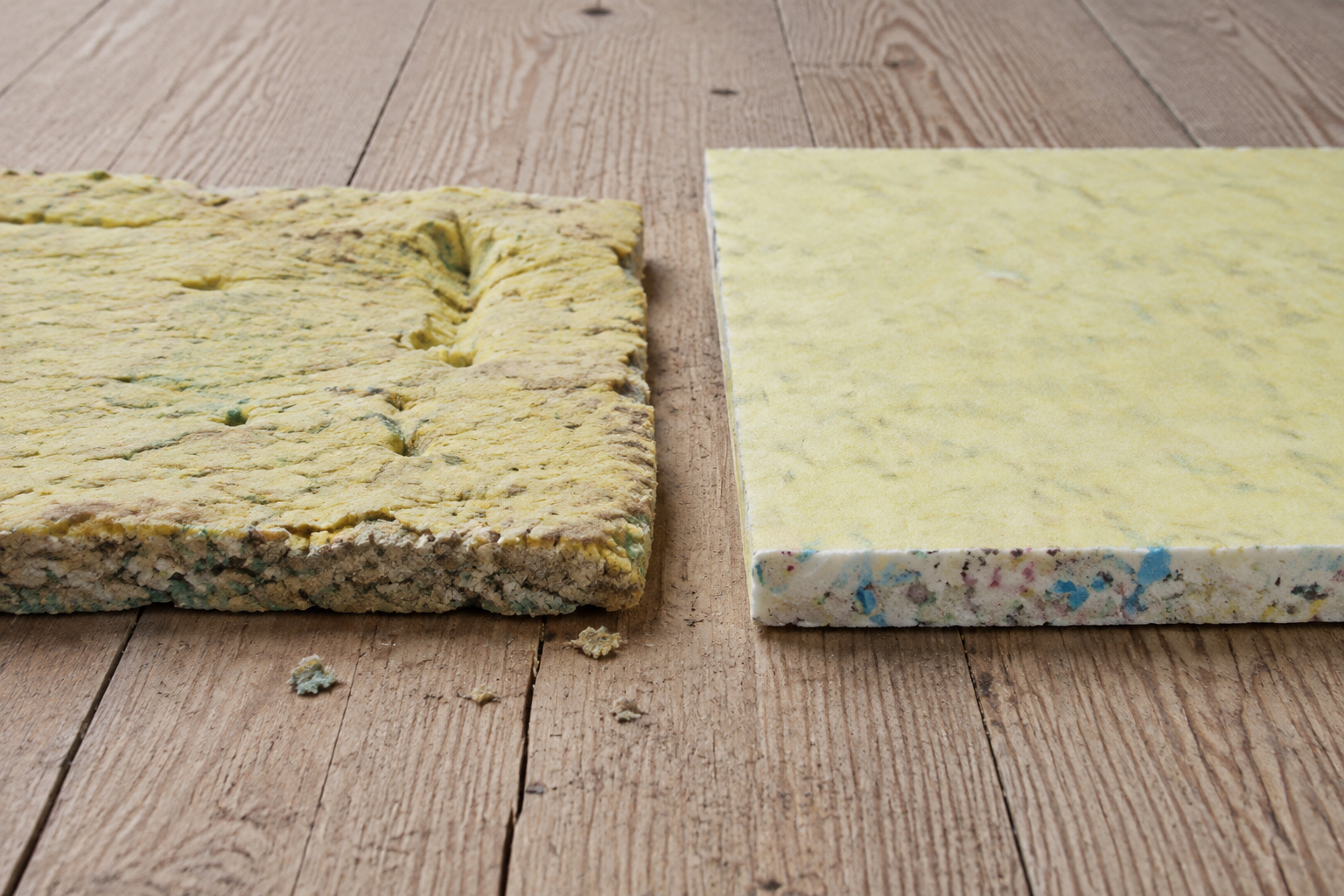
Underlay wears beneath the same footsteps as the carpet above it. A fresh carpet cannot restore flattened support underneath. The decision needs a full-floor inspection and a compatibility check, rather than a quick look at one unworn corner.
Should you keep or replace the underlay?
On a small screen, scroll the table sideways.
| What you find | Practical next step |
|---|---|
| Flattened traffic lanes, permanent dents, hard patches or crumbling | Replace it. The support is no longer consistent across the floor. |
| Damp, mould, contamination or persistent unexplained odour | Investigate the cause and replace affected material before fitting a new floor. |
| Unknown product, changed heating system or incompatible fitting method | Identify and verify the specification. If suitability cannot be confirmed, choose new approved underlay. |
| A very recent product that looks sound throughout | Check its history, condition and the new carpet's requirements with the fitter and manufacturer. |
| The carpet warranty requires new underlay | Follow that requirement even if the existing underlay appears usable. |
Why a good-looking edge can be misleading
The perimeter sees less traffic than the doorway or the route past the sofa. Underlay at the wall can retain its original thickness while the middle is compressed. Once the carpet is lifted, compare the main walking routes, furniture positions and every doorway with the less-used areas.
Look for inconsistent thickness, slow or absent recovery, damaged backing and powder or loose fragments. An uneven base will not become level because the new carpet hides it.
QA Flooring's replacement advice identifies indentations, changes in feel, odour, damp, stains and damage as warning signs. Its recommendation is to replace the underlay when replacing the flooring.
The seven checks before considering reuse
1. Support is consistent across the room
Check heavily used areas as well as edges. Firmly press several locations and compare how the material responds. Permanent dents, hard paths and areas that stay compressed are reasons to replace it. A hand check is useful screening; it does not establish the product's remaining service life.
2. The material and backing are intact
Inspect for splits, brittle foam, loose granules, holes, torn backing and stretched pieces. Lifting and re-taping old joins can cause further damage, so assess the material after removal as well as before moving it.
3. The underlay and subfloor are clean and dry
Do not cover damp or contaminated underlay with new carpet. Investigate leaks, persistent odours, pet accidents or mould, and deal with the source before installation. Replacing the underlay alone will not solve a continuing moisture problem.
4. It lies flat without unstable seams
Curled edges, ridges, gaps and overlapping sections can leave an uneven surface. The installer should decide whether an isolated fitting fault can be corrected or whether the material itself is distorted. Avoid a patchwork of mismatched thicknesses.
5. Its specification suits the new carpet
Check the original product name, firmness, thickness and approved installation method against the new carpet's instructions. A product intended for stretch fitting is not automatically suitable for double-stick installation. Do not repurpose ordinary carpet underlay under laminate, vinyl or wood without explicit flooring-system approval.
6. It still suits the room and heating system
Underlay used in a quiet bedroom may not be appropriate for stairs or a busy hallway. If underfloor heating has been added, check approval for that system and the combined thermal resistance of the proposed layers. A comfortable old underlay may have the wrong tog for the new installation.
7. Reuse meets the carpet's warranty conditions
Read the warranty and fitting requirements for the exact carpet before deciding. As a specific example, Cormar's care and warranty guidance says fitting new carpet on old underlay invalidates its 10 Year Wear Warranty. This is a manufacturer-specific condition, not a statement that every carpet has the same warranty.
If a condition is unclear, obtain confirmation from the carpet manufacturer before ordering. A fitter's view on physical condition does not override the manufacturer's warranty terms.
When might reuse be reasonable?
A carpet may be changed soon after fitting because the owner wants a different colour, rather than because it is worn out. In that situation, a known underlay with light use and a clean history may be worth assessing.
The useful evidence is its product specification, fitting date, condition throughout the room and compatibility with the replacement carpet. All seven checks still apply. There is no single age that makes reuse safe: a recent leak can ruin a young product, while an apparently sound product may still fail the new carpet's requirements.
If those checks cannot be completed, budget for new underlay matched to the room. Avoid choosing the thickest replacement simply to disguise a defective subfloor.
Can you move old underlay to another room?
Only consider it if the product is suitable for the new use and the pieces can form a sound, even layout. Offcuts with enough combined area may still be the wrong shape. Damage from lifting, old taped joins and furniture dents can make relocation impractical.
For a new carpet intended to last, the cost saving should be weighed against the work of lifting, inspecting and refitting worn material. Use the underlay quantity guide to compare the actual number of new rolls needed.
Can you reuse underlay on stairs?
Stairs concentrate use into small areas. Inspect every step, including the material around the nosing and any winders or turns, rather than assuming all the pieces have worn evenly. Replacement with a resilient product approved for stairs is the usual starting point when renewing an older stair carpet.
Our best underlay for stairs and hallways guide explains the relevant specification. Compare suitable stair underlays with the fitter before ordering.
Check the gripper and floor at the same time
Ask the fitter to inspect the subfloor and gripper while they are accessible. Loose boards, significant unevenness or moisture need appropriate attention before the new carpet goes down. Underlay provides support and cushioning; it is not a repair for an unsound floor.
Existing gripper may be retained if the fitter confirms it is secure, correctly positioned and suitable. Replace damaged, corroded or contaminated gripper. We supply carpet gripper and door bars where replacements are needed.
What should you do with the old underlay?
Check your local council or accepting recycling facility for the material and quantity they accept. Do not assume carpet underlay belongs in the household recycling bin. Confirm any uplift and disposal service separately with the fitter, and explain if the waste is damp or contaminated so it can be handled appropriately.
Choosing a replacement
Start with room use and the carpet's fitting requirements, then compare material, thickness, density, tog and acoustic information. Our guides to PU foam versus rubber and 8mm, 10mm and 12mm underlay explain those choices.
Carpet Flooring Supplies offers online, nationwide delivery on a supply-only basis. Arrange the inspection, measuring, fitting and disposal separately.
Frequently asked questions
How often should carpet underlay be replaced?
There is no dependable universal lifespan. Use, material, moisture, fitting and the new carpet's requirements all matter. Inspect it when the carpet is lifted and plan for new underlay when replacing a worn carpet.
Can I put new underlay on top of old underlay?
Do not stack ordinary carpet underlays unless the complete system is specifically designed and approved for it. Extra movement and height can interfere with carpet support, gripper, doors and transitions.
Can underlay be reused after a water leak?
Significant wetting is a strong reason to replace it. The cause and any contamination must be addressed, and the subfloor confirmed suitable before fitting new flooring. Do not judge dryness only by touching the top surface.
Can I replace the underlay in one room only?
Yes. Each room can have an appropriate specification, provided the carpet and installation requirements are met. Check the finished height where the new floor meets adjoining rooms.